You Cannot Ignore Artificial Intelligence

Artificial Intelligence is HERE and we are only Beginning.....

As a test, I requested a psychological profile of the author of this Blog . I told GPT4 to run the report based upon the contents of all the site pages and blogs.

“The author of Domain Buddy’s content presents a clear profile of someone with extensive experience in UK telecommunications, especially VoIP, broadband, and mobile broadband services. Their insights reveal a long-standing familiarity with regulatory and operational challenges in telecom, including evolving broadband needs, customer preferences, and competition with established providers like BT and other mobile operators. The author expresses a critical, often skeptical view of regulatory bodies, acknowledging when they see value in actions by entities like Ofcom but also highlighting frustrations with bureaucratic inefficiencies.

The writing shows a straightforward, sometimes nostalgic tone, often recounting personal anecdotes that detail past business challenges and interactions with colleagues and clients. The author appears pragmatic, focused on providing practical advice for resellers and end users alike, especially on navigating service upgrades, cost savings, and understanding the advantages of fiber, 4G, and 5G broadband options. They also communicate a clear preference for personalized, one-on-one customer service, suggesting they value relationships over impersonal large-scale operations.

The language and references indicate that the author is likely over 50, with decades of industry experience, and highly values long-term customer relationships and ethical business practices over purely profit-driven motives. They show empathy towards small businesses and individual customers, particularly those who are cautious about switching providers, aiming to ease transitions through clear, practical advice and encouragement to capitalize on available options for faster or more affordable broadband solutions【38†source】【39†source】【40†source】.”

A number of massive events have changed all our lives in the last 50 years, and my business life has been directly affected by ALL of them.

Mid to Late 1990s – The first massive event was the WWW and the Internet – probably the most significant change for all of us. A good friend of mine from RAF Cranwell – Howard Bates of 96B Squadron – left Service at about the same time as I did, and made a lot of money in the early days of PCs, software, and then laptops,  and then – Internet access

The second massive event occurred in the early 2000sthe Mobile Phone. The Mobile phone revolution destroyed my telecoms businesses.

The third massive event – Social Media – circa 2015. We have all experienced the explosion of and – some would say – intrusion of Social Media into our lives – Facebook, Twitter and Linked In to name a few of the culprits. With the social media “boom”, the older generation – like myself – risk being left behind.  Social Media also plays an important part in business: people like to know who they are dealing with and expect some personal information and a reference point, and email correspondence is often not enough on its own.

But on the plus side, the Internet has provided a much better way to communicate – if someone publishes memoirs or a book about his/her life or work, there is no way for readers to communicate or give instant feedback to the author or share information with other readers. Now, the internet provides the ability to instantly comment on, or to correct or add to any information. And up until now, I have built only commercial websites with static pages for my telecoms and other businesses. With this evolving Life Blog, I have the right internet “vehicle” to share my many experiences and interests with anyone who is interested!

Which leads me to the fourth massive event – and I want to be on this train – ARTIFICIAL INTELLIGENCE

The more I understand how this technoloy can be used to make money, the more determined I am to learn more and more …. the possibilities are endless.
Updated Oct 2024

You Cannot Ignore Artificial Intelligence Read More »
Punch up at Vauxhall Bridge

My Brush with London Street Crime

Many years ago I was on my commute back to my home in West London. I was in a business suit, and carrying my everyday briefcase. I used the London underground, which connected to an overline railway for the last part of the journey. To get to the overline from the underground, there was a long escalator up and then a bit of a walk through a dark badly lit tunnel to the steps leading to fresh air. Actually, this was Vauxhall Bridge station. While I was standing on the upbound escalator, there was a bit of a commotion and two men rushed past me – one chasing the other and shouting – and it was apparent that the guy following had had his wallet stolen by the thief in front. Anyway, I did not do anything right away, but when I got to the top of the escalator, I could see that the two men were having a struggle, and it appeared that the thief was winning. So as I passed by, I asked the apparent victim if he needed any help: I was told to “f” off by the thief, and the victim did not answer, so I carried on. There was a second man in the tunnel who I think knew the thief – the tunnel was used by a lot of dropouts as a shelter – and he decided to chase after me. As he closed in behind me, I knew that a kick or blow was coming, so turned round at the last moment, used my briefcase as a shield, and threw a right hand punch which connected with this guy’s chin and knocked him out cold. I looked back at the other fight, which had stopped, and then walked on to the main station. leaving my assailant flat on the floor. Moral of the story – I did not know how badly hurt the man was and spent the next few days anxiously watching the local news for any reports!

Punch up at Vauxhall Bridge Read More »

Third Marriage 2015 to 2021 – Personal

Welcome to my Personal Blog! While many of the blog posts here are entirely public and open to everyone, I also write about more sensitive subjects, personal viewpoints, and private information that I prefer to share only with real people and a trusted circle of readers. If you come across a restricted post and would like to read it, please take a moment to fill out the brief form below with your first name, surname, and email address. You will instantly receive a verification link in your inbox. Once you click that link to confirm your email, it will unlock permanent access to every restricted post across the entire site. I truly appreciate your support and understanding and look forward to receiving any comments or feedback!

Third Marriage 2015 to 2021 – Personal Read More »

A Xmas Present from OFCOM!!

OFCOM Does it Again!

Foreword

Just when I thought that I had been complimenting OFCOM – the UK Communications Regulator – far too often recently, they spring another surprise on me!

Locked Handsets

Their latest release dated  17th December 2021 – reproduced in full below – addresses a problem which has been irritating both customers and resellers for years.

Owing to the financial “muscle” of the UK Mobile Networks (the main four being O2, Vodafone, EE and Three) new and existing customers buying a new Mobile package have often been seduced by an offer to include a new Handset as part of that package.

Often most or all of the cost of the new mobile phone handset would be  incorporated into the monthly payments due under the two year + contract entered in to by the customer. In many cases, this was an unbeatable offer for the consumer, since modern handsets are expensive, and payment by instalments a very attractive option.

For the Network, it was a brilliant “win win” strategy: because the customer was tied in to a lengthy contract, they made profits both on the call volume and data usage, AND the sale of the handset.

Last, but not least, the new mobile phone was tied or “locked” to that Network, which means it could not easily be used by the customer seeking a better value contract elsewhere.

Although “Out of Contract” handsets could be “unlocked” this was and still is a tedious and inconvenient process, involving a charge and often a delay.

Now OFCOM have galloped to the rescue, and Mobile Operators can no longer “lock” customer phones. Admiitedly this applies only to new contracts, and also is probably needed to help simplify problems in the offing through the new eSIM product now part of the latest mobile phones, but it is nevertheless a very welcome development.

The Good News Does not Stop There!

Almost as an afterthought, OFCOM also confirms that the Maximum Contract Term for either a new Mobile Phone or Broadband Package cannot exceed 2 years!!

This – coupled with the new directive to simplify switching broadband providers – is exceptionally good news for Consumers, Broadband Brokers and Resellers


OFCOM Release 17th December 2021

“Mobile companies now banned from selling locked handsets

Phones and internet
News

Mobile phone companies are now banned from selling customers locked handsets, under new Ofcom rules that come into force today.

Some companies have still been selling mobile phones that can’t be used on other networks, unless they are unlocked. But this can be complicated for customers and cost around £10 too.

Our research shows that more than a third of people who decided against switching said having to get a handset unlocked put them off changing provider. This means they could be missing out on a better deal.

And almost half of customers who try to unlock their phone have difficulties doing so – including long delays or loss of service.

So we have brought in new rules that come into force today, and mean mobile companies are now banned from selling locked phones. This will make it easier for people to move to a different network with their existing handset, hassle-free.

Any mobile customers who want to change provider can take advantage of the simple text-to-switch process, where you can now get the code you need by simply sending a free text message.

Bundles limited to two-year contracts

Other new measures that come into force today include extending our rules that limit phone and broadband contracts to a maximum of two years, so they cover bundles. Also, if a customer adds a service to their package, providers will not be able to extend the contract periods of the existing services the customer already has without their consent.

This will help give customers more flexibility to switch package or provider, without being locked into long deals.

More support for disabled customers

We’ve also strengthened our existing requirements on phone and broadband companies to provide blind or vision impaired customers with bills and contract information in accessible formats, such as braille or large print.

We’ve extended the scope of these rules, so disabled customers can request that any important information about their service – excluding marketing materials – is provided in a format that is reasonably acceptable to meets their needs, and at no extra cost.

These rules are part of a package of changes we are introducing, to help ensure phone and broadband customers are treated fairly and they can find the best deal for them with ease.

Find out more on how to make sure you’re getting the most out of your phone and broadband services from our consumer advice pages.”

A Xmas Present from OFCOM!! Read More »

Full-fibre broadband in 8 million UK homes?

The Latest OFCOM Report on UK Broadband Availability - Comment

Foreword

On December 16th, 2021 OFCOM published it’s latest report on how UK Fixed Broadband coverage – or “roll-out” – is progressing. According to the Article (reproduced below) 8 million homes in the UK can now theoretically enjoy full fibre – the fastest type of fixed broadband. Less than 2 million Homes have actually got full fibre installed. For the first time, the OFCOM also report on 5G coverage (the fastest mobile or wireless broadband) and claim that approximately half of the UK can now access 5G.

Comment on Full Fibre Rollout

Whilst I would not argue with the figures or the claimed broadband coverage – both of which look impressive – the  more interesting information concerns the “take-up”.

According to the report, if full fibre is now connected to 2 million Homes (presumably mostly city based) then 6 million customers have not upgraded, which means that there is a huge market available to the various broadband salesmen and resellers.

Along with this opportunity comes a big requirement for resellers to educate the customer – after all, many UK Homeowners are quite happy with their existing ADSL for internet browsing etc and have no requirement or desire to download or stream Videos and Films or take part in online Gaming, both of which would need full-fibre speeds.

And many have not as yet given any thought to the ramifications of the BT switch off, the most important being the loss of their traditional phone line.

Here are some of the reasons why Homeowners may resist upgrading:

  • Price – unless there is an immediate cost benefit, any decisions will be delayed. 
  • Inertia/Resistance to Change – the majority of customers are happy with the status quo and need valid reasons or imminent deadlines to change
  • Education – if they are unaware of the advantages of upgrading their Broadband
  • Age – many older customers have a natural resistance to new technology
  • No Necessity – where broadband data usage is minimal (e.g. single occupancy)

Where Better Broadband is Really Needed – 123,000 Homes

The OFCOM report also mentions that around 123,000 homes still do not have access to a ‘decent’ broadband connection – defined as offering download speeds of 10 Mbit/s and upload speeds of 1 Mbit/s. However, orders have been placed under the Government’s universal broadband service that will result in around 6,500 households being connected to full-fibre broadband, and thousands more are expected to benefit from this scheme and others”. 

Recommendations

I would urge any reader who is unhappy with his Home Broadband Service to check out the Universal Broadband Service . Or to contact an Independent Broadband Broker – here is a helpful Video with the names of some recommended Brodband Broker Services.

For information on Fixed Broadband in the UK, choices available and technical terms simply explained, I recommend this website.

Comment on 5G Rollout

The same OFCOM Report states: “We estimate that around half of UK properties are in areas where 5G is available outside from at least one mobile network operator.” 

Again I would not dispute the figures, but I would point out that the key word in this statement is “outside”, meaning outside the Home.

Most consumers would want to use their Broadband inside the Home, and this is where 5G coverage deteriorates rapidly. The strongest 5G signal – and therefore the higher speeds – are available only with (1) “line of sight” to a suitable mast and (2) no impediment, such as trees or property walls or structures in the vicinity. Although it is possible to construct an outside antenna, which connects by cable to a wireless router inside the Home, this does add to the installation costs of the service.

However I am a big fan of Wireless Broadband, which has other advantages over Fixed Broadband and can be cheaper in the long run. I recommend this site for further information on 5G.

Conclusion

There is no doubt that rapid progress is being made in Full Fibre roll out and 5G Broadband, but to improve the “take-up” new customers will need to be properly educated and informed – either by OFCOM, Independent Broadband Advisers and Brokers and Company Salesmen. And if you are a potential Broadband customer, make sure you are aware of the Community Fibre companies operating in your Home Town or Area: these Broadband providers are normally independent, and can offer special deals.

The Full OFCOM news release is published below.

Please feel free to add any Comments to the Blog and/or sign up.


Festive movie favourites in less than a minute – full fibre reaches 8m homes

Telecoms infrastructure
News
  • Full-fibre broadband now available to more than 8 million homes, as rollout accelerates
  • Millions have already boosted their broadband, but many others yet to take advantage
  • Decent broadband at highest-ever level, but more to do to reach remaining 123k homes
  • Around half of the properties in the UK are now in an area with outdoor 5G coverage

Fast, reliable internet connections are now available to more people than ever before, allowing millions of families to download their favourite Christmas movie in less than a minute.

With many people across England, Scotland, Wales and Northern Ireland currently working from home, Ofcom’s annual Connected Nations reports on the availability of broadband and mobile services across the UK.

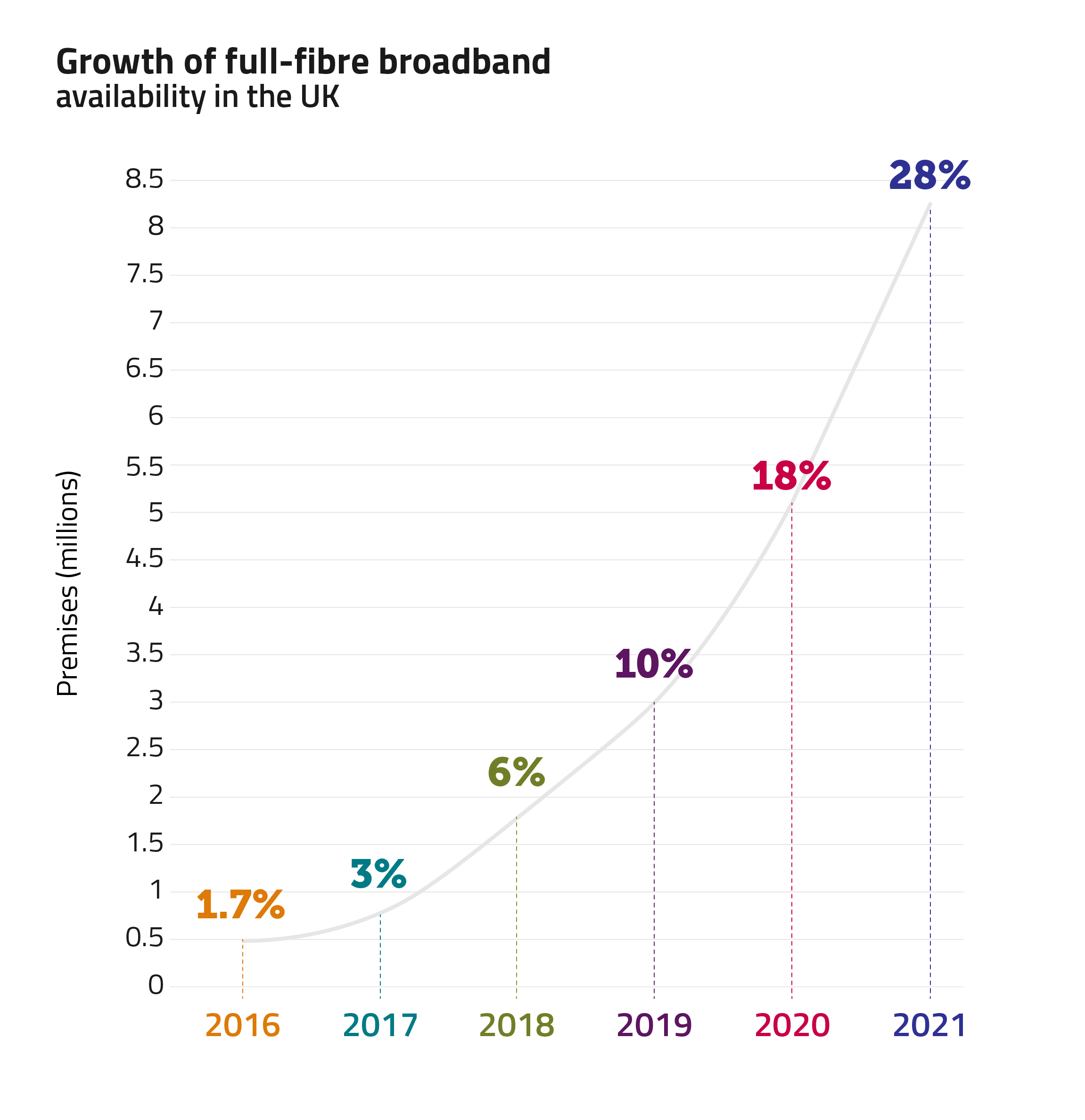
Growth of full-fibre broadband availability in the UK. More than 8 million homes (28%) can now get full-fibre broadband.

It reveals that the rollout of future-proof, full-fibre technology is accelerating at its fastest ever rate. More than 8 million homes (28%) can now get full-fibre broadband – an increase of 3 million properties in the last year.

In 2021, 750,000 homes upgraded to faster, more reliable full-fibre services, taking the number of properties connected to nearly two million. But these homes still represent less than a quarter (24%) of those to which full-fibre upgrades are available.

With 7.4 million broadband customers out of contract and likely to be paying higher prices for slower speeds, many households could upgrade to a discounted full fibre package without paying more than they currently do.

Why would I need full fibre?

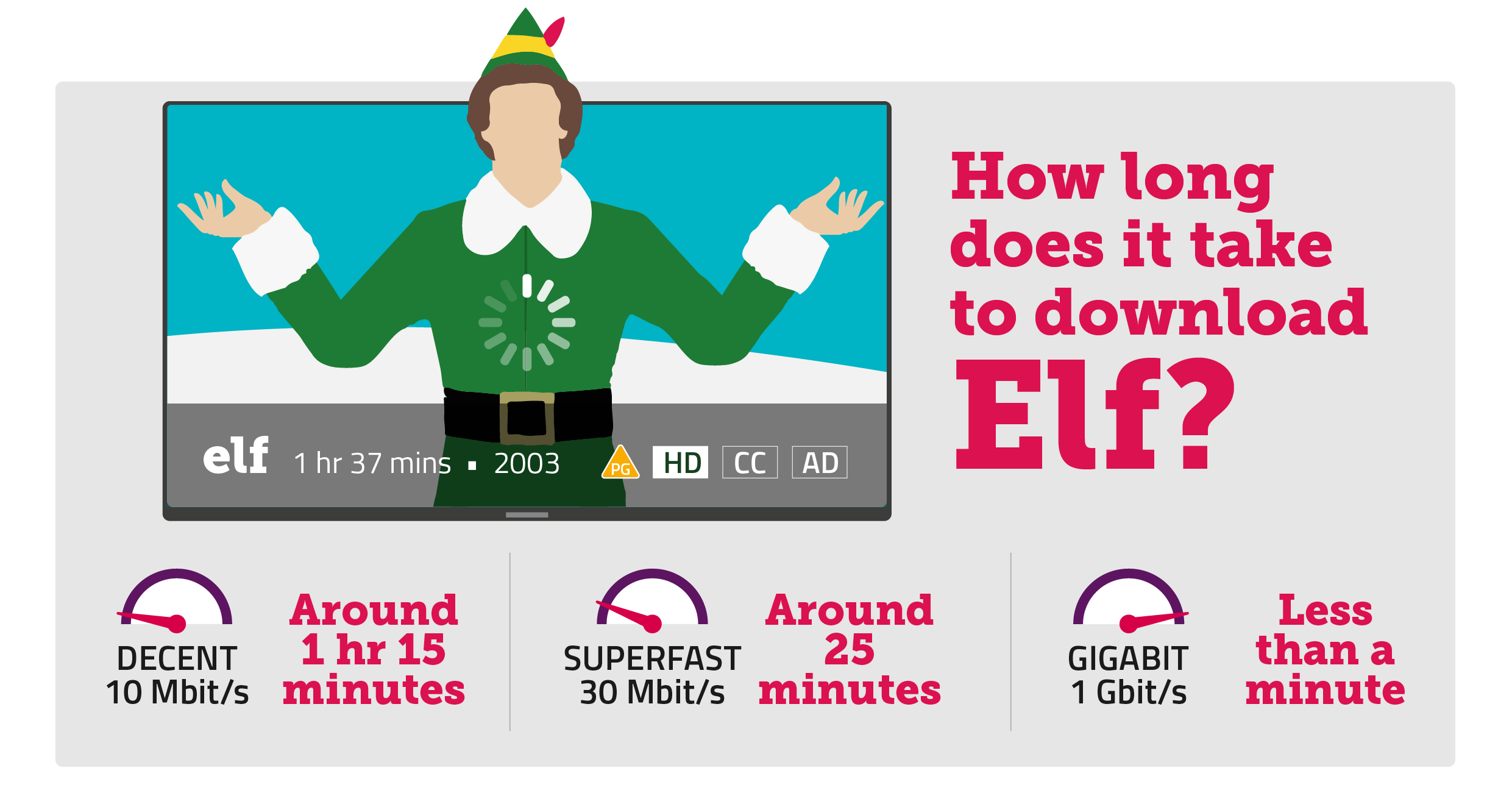
Full-fibre connections – along with upgraded cable networks – can deliver download speeds of up to 1 Gbit/s[1], which could be particularly beneficial over the Christmas period when data use increases. At this speed, families with full-fibre services could download Christmas film favourite Elfin High-Definition in less than a minute, compared with around 25 minutes for those with superfast broadband (30 Mbit/s).

On a decent (10 Mbit/s) connection, it would take around 1 hour and 15 minutes to download Elf. On a gigabit (1 Gbit/s) connection, it would take less than a minute.

Full fibre can better support data-hungry households where family members need to stream, work, game, video-call and study online at the same time. In a year when many people continue to work from home due to the coronavirus pandemic, average monthly data use grew to 453 GB per connection – more than treble the level of five years ago (132 GB).

Connecting the hardest to reach

Around 123,000 homes (0.4% of the UK) still do not have access to a ‘decent’ broadband connection – defined as offering download speeds of 10 Mbit/s and upload speeds of 1 Mbit/s. At this speed, it could take up to an hour and a half to download an HD film.

The UK Government and governments in each of the UK nations continue to deliver projects aimed at making sure people in the hardest-to-reach areas can get the connections they need.

Since its launch in March 2020, orders have been placed under the Government’s universal broadband service that will result in around 6,500 households being connected to full-fibre broadband, and thousands more are expected to benefit from this scheme and others.

Many families now have multiple devices on the go at the same time for work, learning and entertainment – and the festive holidays can see a particular battle for bandwidth.

Full fibre is helping meet those demands, with millions more benefitting from faster speeds and more reliable connections. But some homes in hard-to-reach areas still struggle to get decent broadband, so there’s more work to do to make sure these communities get the connections they need.

Lindsey Fussell, Ofcom’s Network and Communications Group Director

5G coverage revealed

The rollout of 5G mobile continues to make swift progress, and for the first time we have published 5G coverage data.

We estimate that around half of UK properties are in areas where 5G is available outside from at least one mobile network operator. Take-up of 5G-enabled handsets has increased substantially, from just 800,000 last year to more than six million in 2021.

Although doubling in the last year, 5G traffic still accounts for a relatively small proportion of overall mobile data traffic at 3 per cent, with 4G remaining the dominant technology at 91 per cent.

Overall, mobile data consumption increased by 37% in the last year.

Notes to editors

  1. By September 2021, Gigabit-capable broadband was available to 13.7 million homes (47%). This includes full-fibre and upgraded cable networks that are capable of delivering download speeds of 1Gbit/s or higher. This figure has since further increased following Virgin Media O2 completing the upgrade of its network.
  2. We estimate that 5G is available from at least one mobile network operator in the vicinity of 42-57% of premises. The range is based on the information provided to us by operators and informed by our own measurement work.
  3. An interactive version of the report, also published today, allows people to look up how coverage compares in their area.
  4. The International Broadband Scorecard compared broadband availability and take-up across 17 different nations.
  5. Improving your wifi experience
  6. Estimated download speeds used in the Elf graphic are indicative

Related content

Full-fibre broadband in 8 million UK homes? Read More »

The Formula 1 Season 2021 Comment

Mercedes Have Only themselves to Blame

Foreword

I have just finished watching the last race of the Formula 1 Season in Abu Dhabi. Those who know me will also know that Formula 1 is one of my passions, and I will never miss a televised race if at all possible. My favourite F1 Racer is Nigel Mansell – who could ever forget his bravery and commitment and his hugely exciting battles on the track with other “Greats” like Ayrton Senna?

Contrast him with Michael Schumacher – a seven times World Champion – but not a “sportsman” in any sense of the word, winning at least two of his world titles by foul means.

I mention Schumacher because there was a real danger that one of the two protagonists in this year’s championship would resort to – let’s be polite – unfair methods to win the title. 

Mercedes and Red Bull – the two Teams in Contention

The F1 Race teams are run by two individuals – Toto Wolf for Mercedes and Christian Horner for Red Bull. 
I happen to like Christian Horner who is obviously passionate about his job, and backs this up with excellent team management – especially when team strategy is required. In many of the Races this season, the Red Bull race pitstop strategy has been exemplary – they have almost always made the right decisions.
Contrast this with Mercedes, where in several races in 2021, their pitstop strategy has been – to put it politely – questionable, and in my view have undoubtedly cost their lead driver his chance for an 8th World Title. There was no more glaringly obvious cock-up than in today’s final “winner takes all” Race.

The Contestants – Hamilton and Verstappen

I have huge respect for Lewis Hamilton as a Racing Driver and deserved World Champion, his seven World Titles matching Michael Schumacher. Although I feel that his personal opinions about life outside F1 would be better kept to himself, there is no doubting his racecraft and outstanding ability. Above all, he has a deserved reputation as a “fair racer”. He is in my mind the best F1 Driver out there, notwithstanding the result of today’s final race of the sesaon.
At this point I should make it clear that I wanted Hamilton to win.

Max Verstappen is another hugely talented driver, for whom I have great respect. However, his “will to win” is borderline kamikaze – and he will not back out of a confrontation which will result in an accident, even when he is the driver who should clearly give way – as most reasonable drivers who value life and safety would do. This is why I mentioned Schumacher earlier.

Abu Dhabi Race 2021

The Final Race of the season was as exciting and absorbing as one could have hoped for, but for the wrong reasons, as I will explain.

Red Bull’s Verstappen had put together an awesomely good qualifying lap (possibly with some help with slip streaming his team mate Sergio Perez) and started on Pole, with Hamilton in second. 

Hamilton made a blistering start, overtook Verstappen into the first corner, and proceeded to extend his lead, as Verstappen could not make any impression. After some 20 laps or so, Verstappen pitted for fresh tryes,  closely followed by Hamilton (Mercedes got that right – all they had to do was mirror the Red Bull pitstop strategy) and the race positions were then (1) Sergio Perez (2) Hamilton (3) Verstappen – at this point, Perez had not pitted.

The Value of a Good Team-Mate
As Hamilton inexorably closed on Perez, we were then treated to a fierce defence of the lead by Perez – some might say that the defence bordered on “dangerous driving” – but after holding Hamilton back for some laps, which cost Hamilton seven seconds of his lead over third placed Verstappen – the inevitable overtake was accomplished and Hamilton re-took the lead.

I have speculated many times on the value of a determined team-mate, for example Alonso‘s defending against Hamilton in an earlier race which allowed his Alpine team-mate Ocon to win, and possibly – in retrospect – denied Hamilton the World Champonship. Valtierri Bottas – Hamilton’s team-mate – has failed time and time again to  put up any resistance in similar scenarios.

The Finale

Having passed Perez, Hamilton’s lead over Verstappen had reduced to under 2 seconds, and both drivers were now on hard tyres which could last until the end of the race. However, Hamilton started to pull away again, the lead extending lap by lap until it was some 8 seconds, a comfortable gap to defend. At this point, with only six or seven laps remaining, barring some major track incident, the race was Hamiltons.

Safety Car

Unfortunately for Hamilton and Mercedes, the young and relatively inexperienced Williams driver Latifi lost control of his car and slammed into the barriers, with about six laps remaining. This meant a Safety Car, and Red Bull took full advantage by pitting Verstappen almost immediately for a fresh set of soft tyres (the fastest compound)

WHY ON EARTH DID MERCEDES NOT FOLLOW SUIT ???????
This was where Hamilton lost the Race and the Title – inexplicable behaviour from the Mercedes team, which was later compounded by the Race Director, Micahel Masi, in an inexplicable “about turn”, allowing lapped cars to overtake the Safety Car, which meant that Verstappen regained second place immediately behind Hamilton, on brand new fresh tyres.

When the Safety Car pitted and the race restarted with only one lap remaining, there was only going to be one winner.

If I was Lewis Hamilton, I would be extremely unhappy with the Mercedes Team, whatever diplomatic language we may hear from him. A lack of strategic common sense from his support team has definitely cost him an 8th Formula 1 World Title.

Analysis – Final Pit Stop

Red Bull
There was only one option open to Red Bull when the Safety Car was deployed: Verstappen was never going to catch Hamilton if he stayed out with the Hard Compound Tyre. Bringing him in as soon as possible and hoping for an opportunity was a “no brainer”

Mercedes
The situation was admittedly more complex for Mercedes. Their driver had performed brilliantly, done all he could be expected to do, and the only scenarios which could prevent Hamilton from winning were either a car problem (maybe tyre related) or a Safety Car.

Earlier in the race, Hamilton’s engineer was on the radio asking which tyre he would prefer in the event of a Safety Car – Hard or Medium – which meant that they were at least alive to that possibility. This should have meant that strategies had been prepared.

However, once the Red Bull had pitted for new tyres, the Mercedes team seemed unsure what to do: there was TV footage of Mercedes mechanics appearing to be ready for Hamilton pitting, only to then return to the garage – this happened a couple of times while the race continued slowly behind the Safety Car. Presumably they then thought that it was too late to pit, and maybe the Safety Car would remain out for the rest of the race. Unfortunately, this did not happen.

If Verstappen had stayed out on track, and not pitted, the right decision would have been to leave Hamilton there too. However, the reason these guys at Mercedes are paid the “big bucks” is because they should be able to predict factors such as the actions of the Red Bull Team, the likely delay necessary to clear the track (the position of the crashed car) and the number of laps remaining in the race when and if the Safety Car was no longer deployed. 

The correct decision would have been to bring Hamilton in for fresh tyres as soon as possible, and even before Verstappen, if the Pit Lane entrance had been available. Even if he then dropped a couple of places to Verstappen, he would still have had a fighting chance for the win. Once that window of opportunity had closed, they could only hope that the race would finish under the safety car.

Conclusion – An Unfair Result compounded by Inconsistency

The outcome of the final race of the 2021 season and the winner of the Formula 1 World Title was decided by a back marker crashing out of the race. Red Bull and Verstappen should be extremely grateful to Nick Latifi.

And Micahel Masi must go – there is no place for inconsistency in Formula 1 especially from the Race Director, He has lost the confidence of the Teams and many of the drivers.

Please feel free to add any Comment – see below. Did you watch the race?

The Formula 1 Season 2021 Comment Read More »

OFCOM is doing its job!

Latest OFCOM Report - Why You should'nt hesitate to change Your Broadband Supplier.

As my readers will know, I am no fan of Regulatory Bodies, but where they are doing a decent job, I am more than happy to say so. Reproduced below is the latest report from OFCOM (dated 30th November 2021) in its entirety.

Comment

This OFCOM report centres on residential rather than business customers, but if you are “out of Contract” – i.e. free to move suppliers without penalty – the typical savings are about £5 per month. 
This is surely worth having especially since OFCOM have simplified the switching process.
Apart from the cost saving, the benefits may well include a faster Broadband Service

So how do you go about changing providers? 

If you don’t want the hassle of contacting individual suppliers, I recommend the services of a suitable UK Broadband Broker – here is a short Video about Broadband Brokers.

Or  just complete a FREE Broadband Report

OFCOM Publication 30th November 2021

  • 1.3 million broadband users secure better deals since introduction of prompts to shop around
  • Overpayment among mobile customers has dropped by £100m, after operators committed to cut prices when initial contracts end
  • Vulnerable broadband customers who are out of contract have greater protection from higher prices

More broadband and mobile customers are shopping around and signing up to better deals – and saving themselves millions of pounds – following Ofcom rule changes.

Last year, around two thirds (62%) of broadband customers who were nearing the end of their contract either signed up to a new deal with their current provider, or switched to a new one when their existing deal ended. This is up from 47% of customers in this position in 2019.

In addition, the number of broadband customers who are out of contract fell from 8.7 million (40%) in 2019 to 7.4 million (35%) in 2020. On average, these customers pay around £5.10 per month more than they need to.

End-of-contract alerts prompt customer action

Last year, new Ofcom rules came into force that require phone, broadband and pay-TV providers to warn customers when their current contract is ending, and what they could save by signing up to a new deal.[2] We also secured commitments from major telecoms firms to reduce the bills of many out-of-contract customers.

On average, out-of-contract broadband customers pay

£5.10

more than they need to each month

There is evidence that indicates that these timely prompts from providers are working. In our research, two thirds of customers who were sent an end-of-contract notice recalled receiving one. Of those, 90% found it helpful and a fifth reported that they were prompted into action they would not have otherwise taken.

Broadband customers better off

The number of broadband customers who were out-of-contract in 2020 fell by around 1.3 million from the previous year. This reduction was largely driven by people securing a new contract with their existing provider, rather than switching. The average prices paid by broadband customers also fell over the same period, from £39 in 2019 to £38.10 in 2020, while average speeds continued to increase.

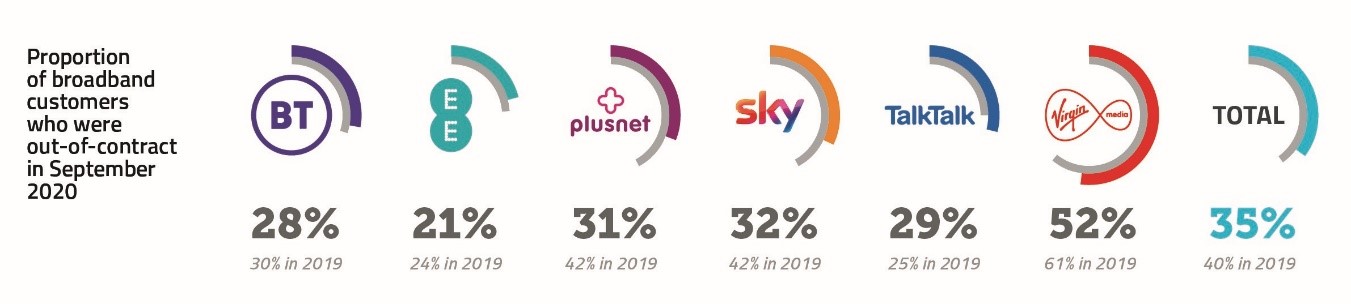
Our analysis also shows that some providers have a greater proportion of out-of-contract customers than others. More than half of Virgin Media’s customers (52%) remained out of contract in 2020 – although less than in 2019 (61%) – while EE had the lowest proportion at 21% (down from 24% in 2019). Plusnet saw the biggest decrease in the proportion of out-of-contract customers year on year – from 42% to 31%.

In September 2020, 52% of Virgin Media customers were out-of-contract. This was higher than Sky (32%), Plusnet (31%), TalkTalk (29%), BT (28%) and EE (21%).

Mobile customers save £100m

Mobile customers on bundled contracts, who pay for their handset and airtime together, are particularly likely to sign up to a new deal when their existing one expires, with just 11% of these customers out of contract. And our research suggests customer engagement in the market is increasing.

Since the commitments we secured came into effect, more than three quarters (76%) of mobile customers on bundled tariffs who were nearing the end of their contract took action to shop around and secure a new deal – up from 70% in 2019.

Also, the amount that bundled out-of-contract mobile customers overpay, relative to customers on like-for-like SIM-only deals, has more than halved – from £182m in 2018 to £83m in 2020.

Vulnerable customers protected

Vulnerable broadband customers who pass the end date of their initial deal now also have greater protection from higher prices, due to the commitments we secured from providers.

On average, these customers pay around £2.30 per month more than their provider’s average price for their service, a significant reduction from £4.40 in 2019.

Prompts from providers are turning into pounds in people’s pockets. It’s great to see more people shopping around and saving money since we took action.

But millions are still potentially paying more than they need to. We’ve made it easier to grab a better deal, so it’s worth taking a few minutes to check what’s out there.

Cristina Luna-Esteban, Ofcom’s Director of Telecoms Consumer Protection

Are you in or out of contract?

Out-of-contract customers don’t have to wait to hear from providers before securing a better deal. Ofcom has a simple, three-step journey to help people find the best offers on the market.

Notes to editors

  1. Figures for broadband and mobile customers nearing the end of their contract who either signed up to a new deal with their current provider, or switched to a new one are from September 2020 and September 2019.
  2. End-of-contract notifications came into force on 15 February 2020. They can be sent by text, email or letter – between 10 and 40 days before a contract comes to an end – and must include:
    1. when your contract is up;
    2. what you’ve been paying until now, and what you’ll pay when your contract is up;
    3. any notice period for leaving your provider; and
    4. your provider’s best deals, including any prices only available to new customers.
  3. Ofcom conducted research among a sample of customers of five mobile and three broadband providers, who had been sent an ECN for a service contract ending in September 2020.
  4. Average broadband prices are based on customers from six providers from whom we obtained data (BT, EE, Plusnet, Sky, TalkTalk and Virgin Media).

OFCOM is doing its job! Read More »

UK Broadband and BT’s SoGGY

Comment on Broadband in Britain and BT's SoGGY

At Power Comms, we are building some new customer sites to promote UK Broadband Broker Services, as a result of which I needed to dive back into this market place and update myself with all the changes to the Broadband services and products.

As a small business owner for the last 40 years or so, I have regarded IT Departments and Marketing Departments with deep suspicion. Whilst they may be a necessary evil in large organisations, it seems to me that the inhabitants of these departments are working to protect their jobs by producing a large amount of b***shit designed to cloak their activities and promote their indispensabiliy to their bosses. One of the ways this is done is to come up with new and impressive names for simple functions or new services. The Telecoms industry is a case in point. 

And BT (British Telecom – the UK’s largest PSTN) does not disappoint. With the advent of the heavily promoted “Switch Off”, their replacement Broadband Service for ADSL and ISDN services is called SoGEA – which apparently stands for “Single Order Generic Ethernet Access”. Who the f*** came up with that one? What idiot in BT’s Marketing Department seriously thinks that the vast majority of BT customers (home-owners and small businesses) will be impressed? Which customer will give a s**t about “Single Order“? What the f*** does “Generic” mean in this context? Why use the technical term “Ethernet“?

Moving on to IT departments, the Broadband industry has spawned a whole new Glossary of Terms and Abbreviations. Some of the new stuff is fair enough – FTTC, FTTP, FTTH, FTTDP – where the FTT stands for Fibre To The …but do we really need GPON, EoFTTC, GEA etc. etc.?

And while on the subject of ridiculous names and abbreviatons, who the hell came up with the names “Openreach” and LLU (Local Loop Unbundling) to describe the sharing of BT’s UK Network, and The Channel to describe the UK Telecom Reseller Business?

Opportunities?
So what opportunites are there for UK telecoms resellers in the new Broadband environment, where the news is all about faster and faster fixed broadband speeds, Fibre Roll Out (another dubious name) and 5G Networks?

OFCOM’s latest initiative will be a big help.

Fixed Line Broadband.
The market of potential customers in the UK for Fixed Line Broadband is broadly divided into two sectors: the large business (for example Corporations and Government Departments with 100s of employees and a giant appetite for Broadband) and secondly the end-consumer – Homeowner and Small Business.

The first sector – big business – is pretty much wrapped up by BT or Openreach. There are signs of some major city-based competiton for the provision of ultra fast broadband – for example Community Fibre in London, who recently raised £400 million to further facilitate their own independent fibre network. However, larger companies usually have their own IT Departments who have something to prove, and will be a hard nut to crack for the average Reseller.

The second sector – Homeowners and small business – is an easier target, even though many of those potential customers have existing contracts with the Incumbent (another dreadful word, which means BT) and the main competition wil be from SoGEA. One major difficulty for resellers will be in overcoming the normal antipathy of customers to changing suppliers, even though it would be to their clear advantage to do so. Resellers will be helped by the BT Switch Off  which will provide a unique selling opportunity, and may be able to persuade some of these customers to consider changing to Wireless Broadband  but I expect fierce competition from the BT salesforce, who will be tasked with doing whatever it takes to retain customers reaching the end of their contract periods.

What About Making and Receiving Phonecalls?
In all the excitement generated by “fibre optic rollout” and the “switch off” and “5G” it is often possible to overlook the fact that the majority of customers in the UK are not that interested in superfast broadband: most of them just need to know that they can continue to make and receive phonecalls and that their internet service will be at least as good if not better. So keeping their phone number is almost always important, together will the ability to make and receive local UK calls (for free if possible). They need to understand if a new handset or router is required, and if they have to pay for it, and how the new VOIP based services will affect them. 

Fixed Wireless Broadband
Although mostly controlled by the “Big Four” (Vodafone, O2 EE and Three), fixed wireless broadband offers good opportunities for Resellers in all customer sectors – including Big Business.

For data hungry companies, a line of sight 5G service to a nearby mast will offer seriously fast Broadband, often matching Leased Line and other FTTP services. Obviously, location and mast proximity will be key factors.

For small businesses and Home Owners, most locations will have 4G coverage, and the broadband speeds available via a suitable fixed wireless 4G or 5G router will often be more than sufficient. And a final mention of  prepaid or PayAsYouGo (PAYG) options, which are available for the purchase of Data in some Mobile Networks – thus avoiding the need for a Contract.

Mobile Broadband – Retail
By UK Mobile Broadband, I mean access to the Internet via a 3G or 4G connection using a SIMcard provided by the Network Operator. Normally, the SIM provided allows both Voice and Data, so that voice calls are made and received over the Network Operator’s routing which gives them control of pricing. There is normally a 12 month (or longer) contract in place which may also include the cost of a locked smartphone – giving the Network Operators another source of income. 

The opportunity here is that many data only SIM products are available from the same Networks, which can be used to provide the 3G or 4G Broadband via an unlocked smartphone or a dongle or MiFi (Wireless Router) on many wireless devices such as a Tablet or a Laptop. The data SIM can also be used with an unlocked wireless router.

VOIP services can be used to make and receive phonecalls to those devices independently of the Mobile Networks. And these SIM packages can be PAYG – so no contract required.

Satellite Broadand
Although Satellite Broadband has been thought of as a niche product, only suitable for consumers in rural areas – i.e. outside traditional cable network coverage or the range of wireless masts – the Broadband speeds and reliability of Satellite Broadband have markedly increased in the last 10 years. 
Providing the installation of a satellite dish prevents no obstacle (planning permission and/or cost) there are good reasons for considering Satellite Broadband, which include redundancy (as a back up service) and the international coverage available. So there are opportunities here for resellers.

Final Thoughts?
A Broadband reseller, will need to be familiar with all the Broadband options available and to be prepared to fight to win new customers by offering them something special. Only one thing springs to mind: first class personal service (one on one is always the best)

UK Broadband and BT’s SoGGY Read More »

Roaming Charges for UK Customers

COMMENT

I suppose it was inevitable that BREXIT would affect the UK’s travelling public.

Sure enough, the National Telecom Operators (both in and outside the UK) have reacted by imposing much higher charges on those customers who use their mobile phones abroad: this is known as “Roaming” and a good explanation of Roaming can be found on our independent Calling Accounts website at https://callingaccounts.com/global-roaming/

Prior to “Brexit”, roaming charges in the EU had stabilised to a reasonable level, but now as can be seen from the OFCOM article reproduced below, the “big four” UK Mobile Network Operators – O2, EE Vodafone and Three – have jumped on the bandwagon, and used BREXIT as a reason (excuse?) for imposing much higher prices.

Our Advice

It is always worth checking out independent SIM cards – providing your phone is unlocked.

Otherwise, you may be able to purchase a “local” data only SIM card affiliated to and provided by your Home Mobile Network, and then use a VOIP solution via a Mobile Phone App (requires Internet Access)

Lastly, Calling Accounts can offer local access numbers in various different countries which bypass the requirement for internet, but this still requires a local SIM card.

FULL TEXT of the September 2021 Release from OFCOM - ROAMING CHARGES INCREASE FOR UK CUSTOMERS

“Travelling abroad? Don’t forget to check for roaming charges”

If you’re looking to head abroad soon, it’s important to be aware of any charges you could face for using your mobile phone when you’re outside the UK.

Since 31 December 2020, the EU rules on mobile roaming charges no longer apply in the UK. That means the amount your mobile provider can charge you for using your mobile phone in EU countries, Norway, Iceland or Liechtenstein is no longer capped.

Some mobile companies have recently announced changes to their charges for using your mobile when in the EU.

  • EE has confirmed that from January 2022, customers joining or upgrading from 7 July this year will pay £2 a day to use their usual data allowances. This charge will not apply to customers when in the Republic of Ireland.
  • O2 has announced a new 25 GB limit for customers traveling to the EU from 2 August 2021. Customers will pay £3.50 per GB after they have reached that limit.
  • Three: From 23 May 2022 customers who have taken out a new contract or upgraded with Three from 1 October 2021 will pay a charge of £2 per day when roaming within the EU and £5 a day when roaming outside the EU. Pay-as-you-go customers and customers who have taken out a contract before 1 October 2021 are unaffected by these changes, as will customers roaming in the Republic of Ireland.
  • Vodafone: From 6 January 2022, pay-monthly personal and small-business customers who join Vodafone, upgrade or change their plan on or after 11 August 2021 will pay a daily charge for using their phone in Vodafone’s European roaming zones. Customers whose Vodafone Pay monthly plan started before 11 August 2021 will pay no additional roaming charges as long as they stay on their current mobile plan. For other business customers, changes will come into effect from November, but charges will not start until 6 January 2022.

Ofcom does not have the power to prevent mobile companies from charging customers for using their services when travelling, but there are a number of measures in place to protect people from running up unexpectedly high bills.

Mobile companies must tell their customers about any contract changes. Where those changes will particularly disadvantage customers, companies must give customers at least a month’s notice and the right to exit their contracts without being penalised.

Providers must also publish details of roaming charges on their website and send you an alert with pricing information when you start roaming.

There is also a £45 (excluding VAT) per month cap on all roaming charges. Your provider will send you an alert once you reach 80% of this and another once you have reached the limit. After this, providers must stop charging for roaming unless you opt-in to continue.

So if you are travelling abroad it is important to check with your provider what charges you may have to pay, before you leave the UK.”

Article reproduced from OFCOM September 6th 2021 

Roaming Charges for UK Customers Read More »

UK Broadband Switching made easy

Fairer Broadband Choices for UK Consumers

Comment

I am no big fan of OFCOM: being part of a small business, we seem to be constantly fighting both our competition and the Regulators.

OFCOM – the UK Communications Regulator – has an unusually large remit.

From initial responsibility only for the telecommunications sector in the UK, it has now assumed control over all types of communication in the UK, including Broadcasting (TV Satellite etc) and even the Postal Services.

My experience is that too often OFCOM has been guilty of siding with the large operators in the Telecoms sector, and not supporting the smaller. Recent examples are the handling of the “Nuisance Calls” problem and the proposal to do away with revenue share on Non Geographic Numbers

The first has led to large rises in call charges across the board affecting both the small business and the end consumer.

The second will adversely affect small businesses in the Telecoms sector, and lead to a reduction of choice of service for consumers.

However, this latest action by OFCOM is very good news for consumers of Broadband. For too long, the customer has been “locked in” to a Broadband Service  and this latest move by OFCOM is to be applauded!

Full Text of the September release from OFCOM - Good News for UK's Broadband Customers

“Simpler broadband switching in as little as a day”

“Broadband and landline customers will find it easier than ever to change provider and secure a better deal, under a new ‘One Touch Switch’ process announced today by Ofcom.  

The change means all home broadband users – including cable and full fibre customers – will only have to contact their new company to switch, with no need to speak to their current provider before making the move.  

People can already switch between providers on Openreach’s copper network, such as BT, Sky and TalkTalk by following a process where their new provider manages the switch. 

But for the first time, customers switching between different networks or technologies – for example, from a provider using the Openreach network to one using CityFibre’s, or from Virgin Media to Hyperoptic – will be covered by the simpler process. 

Currently, these customers need to contact both their existing and new provider to co-ordinate the switch, which includes trying to bridge the gap between the old service ending and the new one starting.

An Ofcom news release with more detail about the announcement is also available.”

Article reproduced from OFCOM Spetember 26th 2021

UK Broadband Switching made easy Read More »